$3,250,000 USD

818-390-4181

3123 Livonia Ave
Los Angeles, CA 90034
Cheviot Hills
OVERVIEW
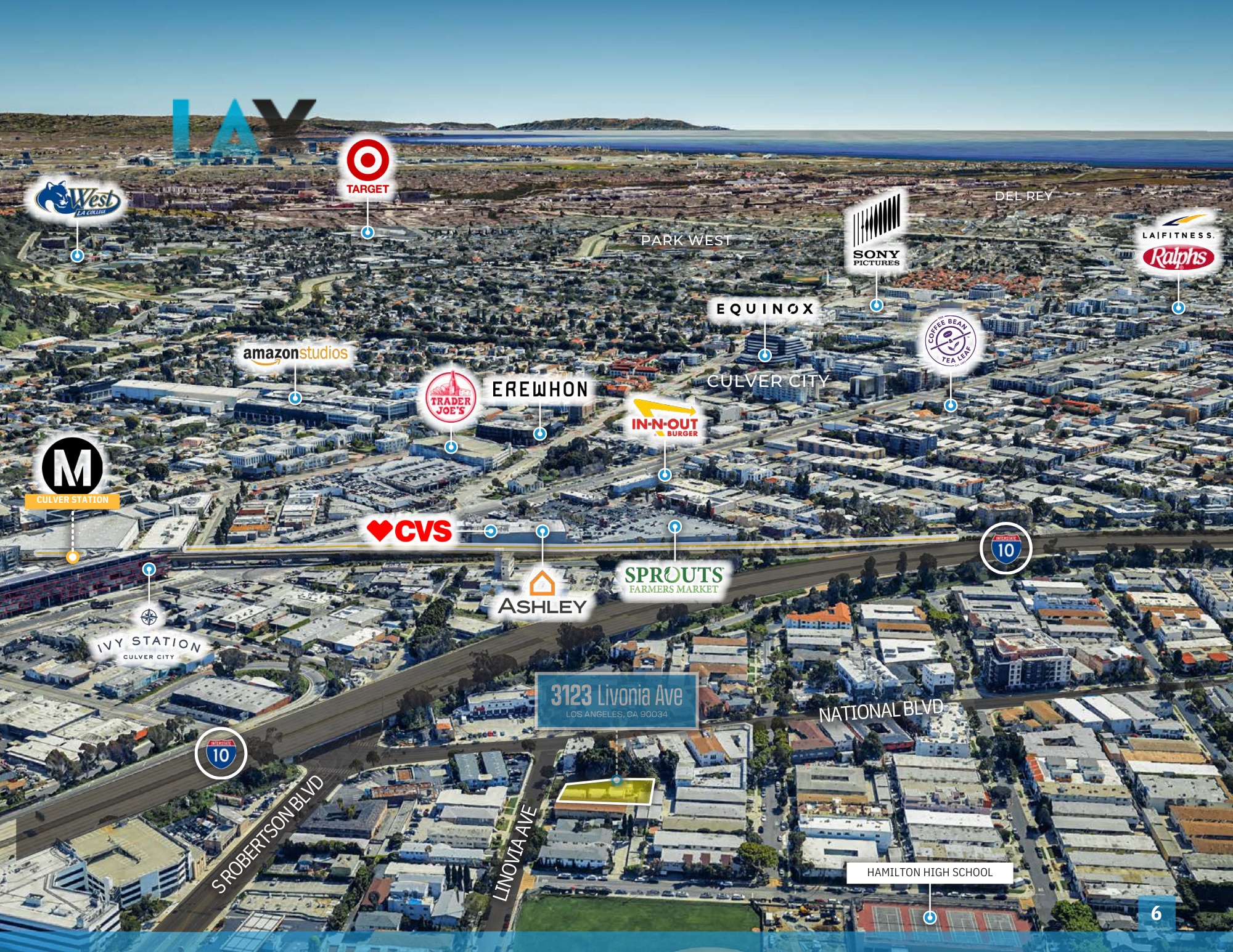
Marcus & Millichap is pleased to present 3123 Livonia Avenue, a prime ±12,866 SF development site in the Palms neighborhood of West Los Angeles, located just steps from the Robertson and National intersection at the gateway to Culver City and the Westside. The current vacant property offers a high-density redevelopment
opportunity under Los Angeles’ most advantageous housing incentive frameworks, including the Mixed-Income Incentive Program (MIIP) in combination with CHIP. This structure allows developers to significantly increase unit density, deliver a modern mixed-income apartment project, and benefit from zero parking requirements, substantially improving design efficiency and project economics. As a conceptual planning guide only, a MIIP + CHIP scenario may support approximately 12–13 units per residential floor. This assumes a gross floor plate is approximately 8,000 SF with net rentable roughly 6,400 SF per floor after reducing for hallways, staircases, etc. The first
floor includes lobby area, trash room, and mail room; thus, reducing yield by roughly two units. Under this framework, total unit count could approximate 82–89 units, with a potential mix of ~90% micro units and ~10% small three-bedroom units, while dedicating only a limited portion of units to affordability. Buyers should rely on their own independent analysis and expertise. Given the site’s prime West LA location, proximity to transit, employment, and lifestyle amenities, MIIP + CHIP represents a best in-class development strategy for capturing strong Westside rental demand while maximizing density and long-term value. AHIP/CHIP remains an alternative pathway for fully affordable projects, though the property’s market fundamentals strongly favor a mixed income, market-driven approach. Notable incentives include but not limited to:
• Unlimited Density.
• 45% increase in FAR, making it 4.35.
• 22 feet/2 story height increase to 67 feet, which can be further
increased to 7 stories if 10% of the units are 3 bedrooms. Seven
stories is the optimal approach.
• Affordability: 12% of the total units need to be ELI (Extremely Low
Income).
• Additional incentives are available, such as reduced setbacks and
common open space.
FOR SALE DETAILS
PRICE
$3,250,000 USD
PRICE/ACRE
$11,003,410/AC
PRICE/SF
$253 USD /SF
# OF LOTS
-
LAND DETAILS
PROPERTY NAME
Development Opportunity with Income - Palms
PROPERTY TYPE
Land
PROPERTY SUBTYPE
Residential
LAND PROPOSED USE
Apartment Units, Apartment Units - Condo
LAND ACRES
0.3 AC
LAND SF
12,866 SF
OFFSITE IMPROVEMENTS
Sewer, Water, Electricity, Gas, Streets, Curb/Gutter/Sidewalk, Cable, Telephone, Irrigation
ZONING
R3-1
APN/PARCEL ID
4311-027-012
ASK ABOUT THIS PROPERTY
Please correct the highlighted field(s).

818-390-4181
By clicking the button, you agree to Showcase's Terms of Use and Privacy Notice.
Please correct the highlighted field(s).
818-390-4181
By clicking the button, you agree to Showcase's Terms of Use and Privacy Notice.